
Mapping your anatomy
Facial anatomy varies from person to person and rarely matches the textbook exactly. Ultrasound helps your provider understand your individual anatomy so a treatment can be planned around the way your face is actually built.

luma
Ultrasound-guided planning for safer, more precise cosmetic injectable care — an added layer of safety alongside careful technique and clinical judgment at luma in Calgary.
Facial ultrasound is a real-time imaging tool that lets your provider see beneath the surface of the skin before, during, and after an injectable treatment. At luma, Dr. Amane Abdul-Razzak, Dr. Sydney Malenfant, and Dr. Amanda Schreiner use it as another layer of safety along with all of our other safety strategies — not as a replacement for careful technique, conservative planning, and clinical judgment, but as a way to add precision to them.
Every face is a little different from the textbook. Ultrasound helps your provider understand your individual anatomy, see where any previous filler is sitting, and confirm that treatment is placed the way it was planned. The goal is the same one that guides all of our work: results that look subtle, natural, and rested, reached as safely and precisely as we can.
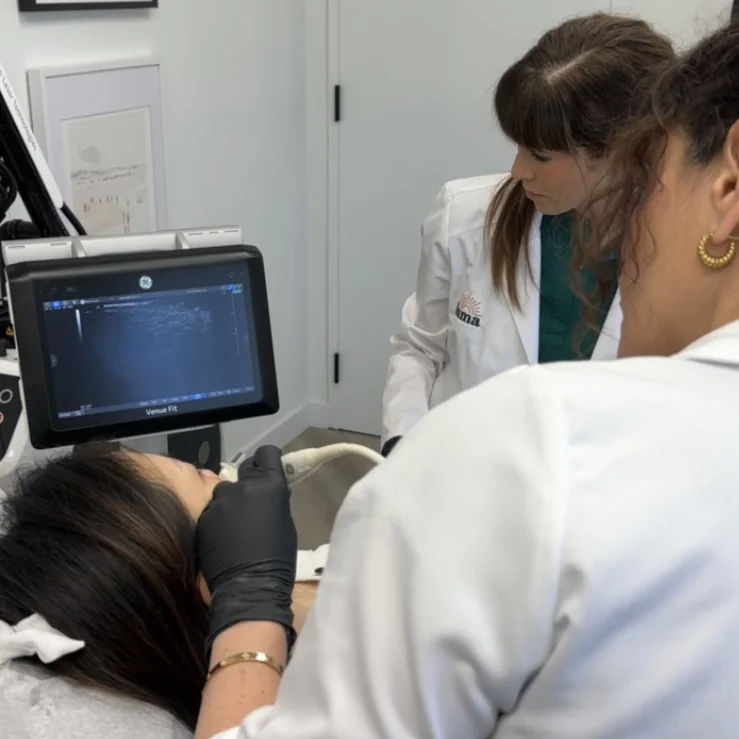
Facial anatomy varies from person to person and rarely matches the textbook exactly. Ultrasound helps your provider understand your individual anatomy so a treatment can be planned around the way your face is actually built.
If you have been treated before, ultrasound can show where earlier filler is sitting and how it has settled over time — information that helps your provider decide whether to build on it or dissolve first before a new treatment.
After an injection, Dr. Amane Abdul-Razzak, Dr. Sydney Malenfant, and Dr. Amanda Schreiner may scan the area to confirm the product ended up where it was intended. Dr. Amane thinks of this as a form of quality assessment that has helped refine her technique over time.
With powerful regenerative injectables such as Radiesse and Sculptra, including the luma Neck Protocol, precise placement matters. Ultrasound helps optimize technique when planning these treatments.
Nose filler is an advanced procedure, not a “lunchtime rhinoplasty.” Because the area carries real safety considerations, ultrasound is one of the tools used at luma to understand nasal anatomy, check earlier filler, and review placement afterward.
Understanding how filler behaves, along with anatomy and ultrasound, helps your provider avoid an overfilled or puffy look and keep results tasteful and natural-looking.
Dr. Amane Abdul-Razzak, Dr. Sydney Malenfant, and Dr. Amanda Schreiner use facial ultrasound in their practices. Dr. Amane uses it daily in clinic. With a Master of Science in Health Research Methodology and published cosmetic medicine research, she favours evidence-informed planning and treats injectables as a form of medicine — slowing things down, getting to know your goals, and building a personalized plan rather than chasing trends or quick fixes.
Dr. Amane also teaches facial ultrasound to other cosmetic injectors, including hands-on small-group courses held at luma, and stays connected to a growing network of clinicians incorporating ultrasound into their own practices.
Ultrasound scanning may be used in a few situations:
Facial ultrasound complements careful technique and experienced clinical judgment; it does not replace them. Whether it is used at your appointment depends on the treatment and what your provider feels is helpful for your plan.
Not necessarily. Your provider decides when ultrasound adds useful information for your treatment and plan. It is one tool among several, used when it helps improve precision or confirm a safe approach.
Ultrasound can often show where earlier filler is sitting and how it has settled, which helps your provider decide whether to build on previous treatment or dissolve it first before a new one.
No. No tool removes all risk. Facial ultrasound is used as an added layer of safety and precision alongside careful technique, conservative planning, and clinical judgment.
No. Here, ultrasound is an imaging tool used to see beneath the skin and plan injectable treatments. It is not a skin-tightening device and is not a treatment on its own.